
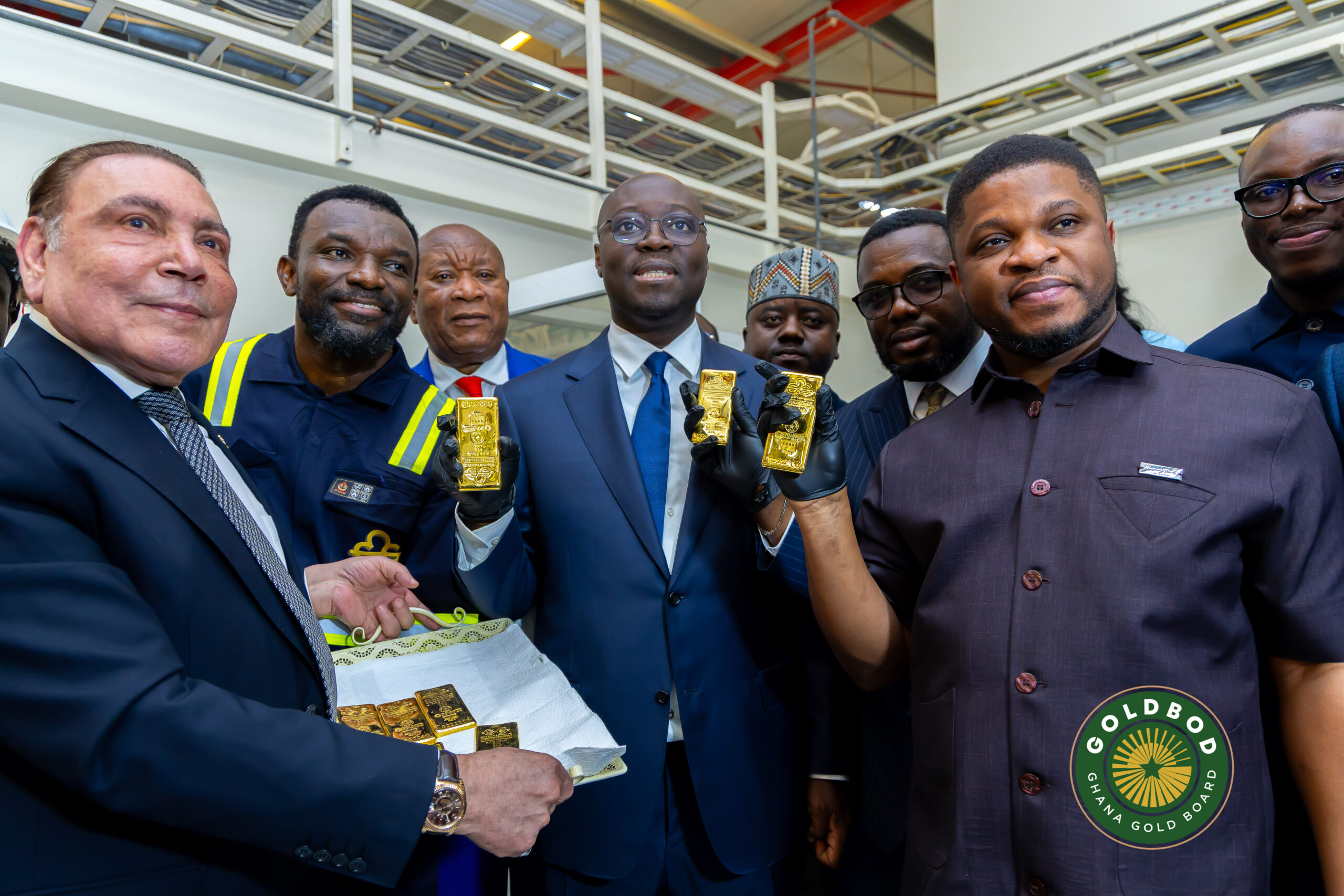
The Minister for Finance and Economic Planning, Dr. Cassiel Ato Forson, has announced a sweeping overhaul of Ghana’s gold acquisition framework, positioning the Ghana Gold Board at the centre of a new strategy aimed at strengthening foreign exchange reserves, enhancing local value addition and tightening regulatory oversight across the mining sector.
Addressing Parliament on Wednesday, February 25, 2026, the Minister disclosed that government will, in the short term, revise the current arrangement under which the Bank of Ghana acquires 20 per cent of large-scale gold output.
To ensure strict compliance by mining companies, government will establish an Inter-Agency Committee co-chaired by the Ministers for Finance and Lands and Natural Resources, with membership including the Governor of the Bank of Ghana as well as the Chief Executive Officers of the Minerals Commission and the Ghana Gold Board.
Under the new arrangement, the Lands Minister will invoke the state’s pre-emption rights under the Ghana Gold Board Act, 2025 and the Minerals and Mining Act, 2006 to purchase a minimum of 20 per cent of large-scale gold output, equivalent to at least 0.57 tonnes per week.
The gold will be acquired strictly in doré form and processed locally to promote value addition. Transactions will be conducted in cedis at the prevailing interbank exchange rate and at a discount to be determined by the parties based on volume.
According to the Minister, the doré purchased under the new acquisition arrangement will be refined by local refineries before being shipped to refineries certified by the London Bullion Market Association for melting, bar casting and stamping, after which it will be added to Ghana’s physical gold reserves.
He stressed that the gold will only be sold by the central bank subject to prior approval of Cabinet and Parliament.
Dr. Forson said the measures are designed to ensure strict enforcement of commitments by large-scale mining firms, promote local value retention, enhance transparency and good governance, and reduce acquisition costs, while supporting local refineries to attain LBMA certification standards.
He noted that the Ghana Gold Board is strategically positioned to enforce the arrangement as it maintains field officers in the gold rooms of all large-scale mining firms and assays samples of gold output prior to export.
He further revealed that the framework has been successfully piloted with nine large-scale mining companies over the past six months.
Turning to the Artisanal and Small-Scale Mining (ASM) sector, the Minister announced that the Ghana Gold Board will implement strategies to purchase a minimum of 2.45 tonnes of ASM gold weekly through official channels to generate foreign exchange for the country.
Over the next three years, the Board aims to mop up approximately 127 tonnes of ASM gold annually, which at current price levels is projected to generate more than US$20 billion in foreign exchange each year.
To achieve this, the Board will arrange sufficient funding to acquire three to four weeks of gold supply to ensure continuous market participation.
Effective March 2026, the Ghana Gold Board will assume full responsibility for signing off-take agreements and managing the sale of all ASM gold it procures, a move the Minister said will ensure end-to-end trading efficiency, mitigate trading losses and pursue trading gains for the country.
The Board will also deploy gold-backed derivative trading programmes and hedging strategies to manage market risks, while introducing price incentives, including spot world market purchases and bonuses for licensed miners, to discourage smuggling and ensure adequate volumes are channelled through official systems.
In the medium term, the policy will promote ASM formalisation, value-chain traceability and local gold refining to reduce costs and maximise export returns sustainably.
Additionally, the Bank of Ghana and the Ghana Gold Board are expected to sign an agreement mandating the Board to sell all foreign exchange accrued under the policy exclusively to the central bank at a mutually agreed cost.
The Ghana Gold Board has also been tasked to implement trading reforms to reduce operating costs and to facilitate the establishment of modern LBMA-compliant processing plants in partnership with private investors, particularly to optimise gold recovery in the ASM sector and promote sustainability.
The Finance Minister described the reforms as critical to strengthening Ghana’s external buffers and ensuring that the country derives greater long-term value from its gold resources, reinforcing the Ghana Gold Board’s role as a central vehicle in managing and consolidating the nation’s gold reserves.