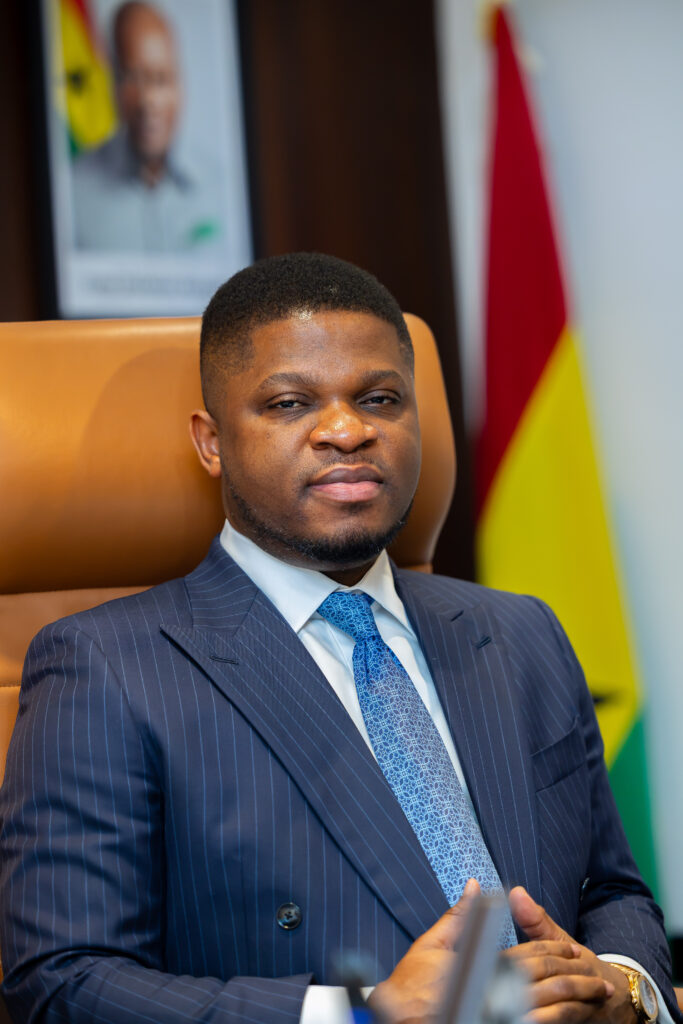

The Chief Executive Officer of the Ghana Gold Board, Sammy Gyamfi, Esq. has firmly rejected suggestions that the GoldBod has recorded losses under its operations, amid public debate sparked by an International Monetary Fund (IMF) country report on Ghana’s Gold-for-Reserve programme.
Speaking on TV3’s Key Points program on Saturday, December 27, 2025, Mr. Gyamfi clarified that the IMF’s reported figure of a US$214 million loss relates to accounting assessments concerning the Bank of Ghana’s Gold-for-Reserve programme, and not to the financial performance of the GoldBod.
He stressed that at no point did the IMF state that the Ghana Gold Board itself had incurred losses.
“The GoldBod has not made losses. We have made surpluses, and our financials have been published in accordance with the law,” the CEO said, adding that GoldBod’s quarterly financial statements are publicly available on the institution’s website for verification.
Mr. Gyamfi explained that GoldBod, established under the Ghana Gold Board Act, is not a conventional commercial entity driven primarily by profit. Rather, it is a mandate-driven strategic institution created to generate foreign exchange for the country and support the accumulation of gold reserves by the Bank of Ghana.
He noted that this distinction is clearly reflected in the law, which uses the term “surplus” instead of “profit.”
“If GoldBod were to make losses in the discharge of its mandate, we would not shy away from that. We would account for it transparently and explain the benefits, if any. But the facts are clear; GoldBod has not made losses,” he stated.
The CEO further explained that GoldBod is barely eight months old and, under Section 76 of its establishing Act, inherited the assets, liabilities, and contractual obligations of the defunct Precious Minerals Marketing Company Limited (PMMC), including arrangements with the Bank of Ghana under the Domestic Gold Purchase Programme, which began in 2022.
Addressing the IMF’s assessment of losses under the Gold-for-Reserve programme, Mr. Gyamfi said the matter relates to unresolved accounting and financial reporting treatments, which the Bank of Ghana is currently discussing with the IMF and its external auditors.
He disclosed that the IMF itself had agreed to allow external auditors to resolve these issues, acknowledging that different accounting treatments could significantly affect reported profit or loss figures.
“The Bank of Ghana is not running away from losses,” he said, pointing out that the central bank has publicly recorded significant losses in recent years without controversy.
“If the IMF’s figure of US$214 million is eventually confirmed, it would represent a reduction in the recurring losses the Bank of Ghana has historically made”, he stated.
Mr. Gyamfi also rejected claims that losses under the programme indicate poor pricing or inefficiency, explaining that the Gold-for-Reserve policy was never designed to generate profits.
He recalled that when the programme was introduced in 2022, the Bank of Ghana deliberately priced gold purchases at or near spot prices to compete with smugglers and secure much-needed foreign exchange, despite knowing this would entail intrinsic costs.
“Nobody buys gold at spot price to make profit,” he said, adding that the policy objective was macroeconomic stability, not margins.
He further argued that attempts to price gold at deep discounts to achieve profitability would render Ghana uncompetitive, drive gold back into smuggling channels, reduce foreign exchange inflows, weaken the cedi, and worsen inflation and the cost of living.
Highlighting the broader economic impact of the programme, the GoldBod CEO cited significant currency appreciation, sustained declines in inflation, reductions in food prices, and substantial savings on external debt servicing and imports as key benefits that far outweigh the reported costs.
He noted that the IMF itself has not said the programme is bad or should be stopped, rather the IMF said the cost should be properly treated in Ghana’s books.
“Whether it sits in the books of the Bank of Ghana, GoldBod, or the Ministry of Finance, it is still the cost of Ghana,” he reiterated.