
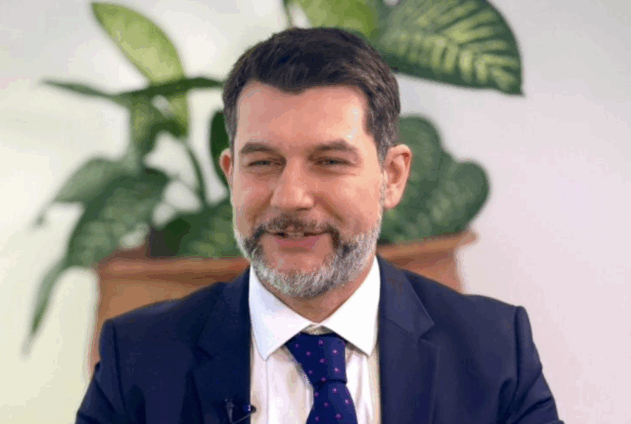
The International Monetary Fund’s Resident Representative in Ghana, Dr. Adrian Alter, has publicly dispelled claims that the Fund’s latest review has labelled Ghana’s Domestic Gold Purchase Programme (DGPP) as loss-making or has attributed the recently reported US$214 million cost to the Ghana Gold Board (Goldbod), the Ministry of Finance or the Bank of Ghana.
Speaking to Joy News, Dr. Alter stressed that the programme is being judged on a balanced set of outcomes, benefits and risks, and that the IMF’s assessment was intended to improve transparency and strengthen programme design, not to blame any participating institution.
Dr. Alter noted that paragraphs 32 to 36 of the Staff Report explicitly recognise the positive impact of the DGPP since its inception.
“On the benefit side, the DGPP has helped to accumulate reserves and has also alleviated some of the pressure on the foreign exchange market in difficult times,” he explained, adding that the programme allowed the central bank to diversify its reserve build-up and improve export performance when global financing conditions were tight.
He also pointed out that the US$214 million figure cited publicly was not a finalised loss, but an estimate of exposure based on unaudited accounts, a distinction critics have largely ignored.
“The data reviewed was not finalised because 2025 accounts have not been audited so the expected losses might change up or down once the audit is completed,” he stated.
Crucially, Dr. Alter rejected suggestions that the IMF was accusing Goldbod or the Bank of Ghana of mismanaging the programme.
“Ultimately, we did not want to assign any blame on Bank of Ghana, Goldbod or the Ministry of Finance,” he said.
“What we wanted to achieve with this disclosure is more transparency and risk management so that we minimise costs while preserving benefits,” he added.
He emphasised that the figure the Fund described was a quasi-fiscal cost, meaning it reflects market exposure to a public policy operation that, in the IMF’s view, should be placed on the government budget rather than the central bank’s balance sheet.
The rationale, he said, is to ensure that the Bank of Ghana remains strong enough to deliver on its primary mandate of price stability.
Dr. Alter also underlined a core feature of global gold markets that has been largely absent from recent commentary, price volatility and inherent market risk.
“Gold is also volatile so there is market risk involved,” he stated, adding that trading margins, financing conditions and exchange rate movements naturally introduce cost fluctuations into every gold reserve accumulation policy, whether in Ghana or elsewhere.
The IMF’s recommendation, he said, is therefore two-pronged: retain the DGPP because it is delivering benefits, and reinforce governance, risk management and transparency especially around the Goldbod-linked procurement and aggregation channel.
His comments mirror remarks recently delivered by the Governor of the Bank of Ghana to Parliament’s Public Accounts Committee, where Dr. Johnson Asiama indicated that stakeholders including Goldbod will meet to reform aspects of the programme’s structure, particularly in relation to funding and how exposures are recorded.
For the Ghana Gold Board, the clarification marks a major turning point in the public debate.
The institution had earlier rejected claims by some opposition voices that Goldbod had incurred or caused a US$214 million loss, arguing that the figure reflects central bank accounting treatment rather than any operational deficit. The IMF’s language appears to fully align with that position.
Dr. Alter concluded by reaffirming that the programme has strong potential and remains important to Ghana’s macroeconomic strategy.
“The DGPP has brought lots of benefits and those are acknowledged. With better governance and sustainability, the programme can bring even more benefits,” he reiterated.