
Ghana’s artisanal and small-scale mining (ASM) sector recorded a historic breakthrough in 2025, outperforming the country’s large-scale mining sector in both the volume and value of gold exports for the first time, following the intervention of the Ghana Gold Board (GoldBod) under the Gold-for-Reserves (G4R) programme.
Official data shows that as of December 24, 2025, large-scale mining companies exported a total of 96.6 tonnes of gold, valued at approximately US$9.2 billion.
In contrast, the ASM sector exported 103 tonnes of gold, generating about US$10.8 billion in foreign exchange, marking an unprecedented milestone in Ghana’s gold export history.
The remarkable turnaround has been attributed largely to the operational reforms introduced by the GoldBod in its first year of existence.
Established to formalize the ASM gold trade, improve traceability, and optimize foreign exchange inflows, GoldBod’s intervention has significantly increased the volume of ASM gold captured within the formal economy.
Historical data from the past seven years highlights the scale of the transformation. In 2018, despite a nationwide ban on small-scale mining, ASM gold exports stood at 75.7 tonnes valued at US$2.8 billion.
This declined to 53.4 tonnes in 2019 and further to 39.3 tonnes in 2020. The situation worsened drastically in 2021, when the imposition of a 3 percent withholding tax on unprocessed ASM gold led to a collapse in exports to just 3.4 tonnes, valued at US$185 million.
Although the reduction of the withholding tax to 1.5 percent in 2022 and subsequent years resulted in a gradual recovery; 22 tonnes in 2022, 37.4 tonnes in 2023, and 63.6 tonnes in 2024, the most dramatic improvement occurred in 2025.
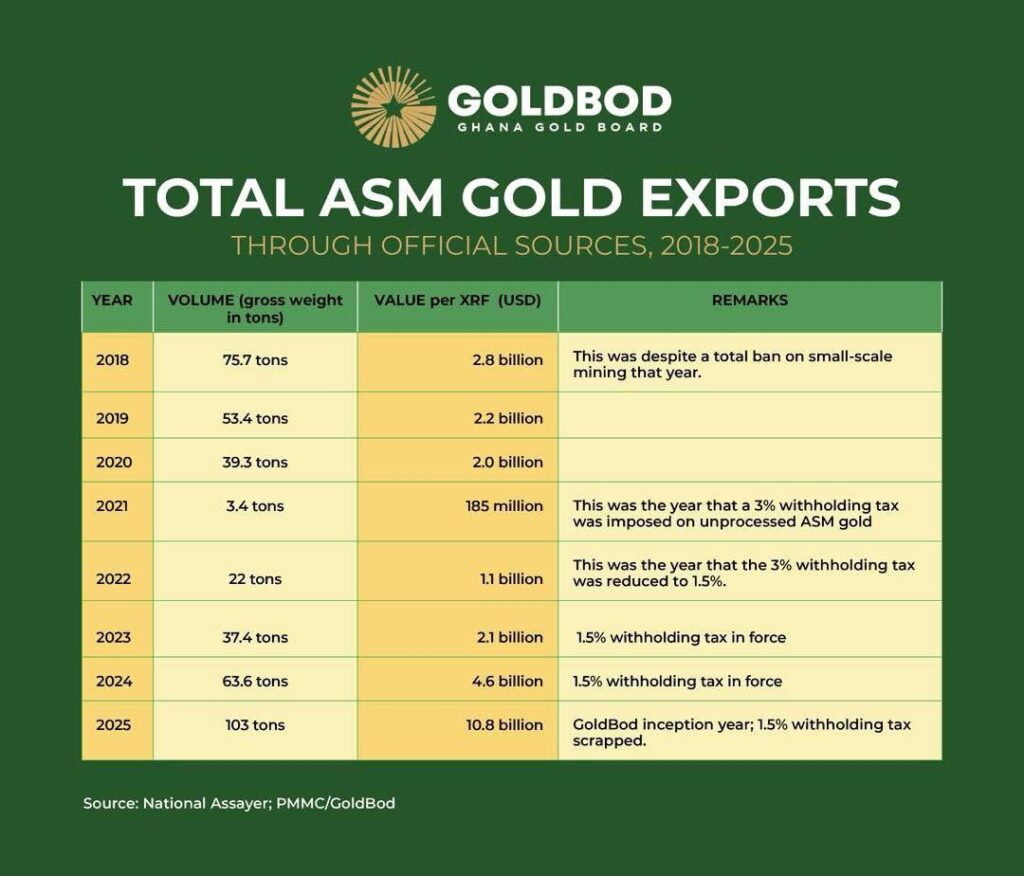
That year marked the inception of GoldBod and the complete removal of the withholding tax on ASM gold, a policy shift that coincided with a sharp rise in export volumes to 103 tonnes.
While some critics have attributed the surge solely to record-high global gold prices, GoldBod officials insist that the data tells a more nuanced story.
According to CEO of the GoldBod, Sammy Gyamfi, Esq., the exceptional performance in 2025 reflects not only favorable international prices but also the effectiveness of GoldBod’s gold aggregation and market-mopping strategy, which successfully drew unprecedented ASM volumes into the formal export system.
“This data clearly shows that Ghana’s strong ASM export performance in 2025 is not just price-driven,” he noted.
“It is also the result of deliberate policy choices and institutional reforms that incentivized miners to sell through formal channels,” he added.
The figures further underscore the risks associated with imposing excessive taxes, discounts, or deductions on local ASM gold purchases in pursuit of short-term profit.
The collapse in export volumes in 2021 remains a stark reminder of how such measures can drive gold trading into informality and smuggling, ultimately depriving the state of revenue and foreign exchange.
With the ASM sector now contributing more gold exports than large-scale mining, analysts say the GoldBod’s approach represents a critical shift in Ghana’s resource management strategy, one that prioritizes volume capture, formalization, and foreign exchange accumulation over narrow fiscal extraction.
As Ghana looks ahead, the 2025 ASM export performance is being viewed as a benchmark for how effective institutional reform, aligned incentives, and market realism can unlock the full economic potential of the country’s gold sector.