
A growing number of journalists have contributed to the public debate sparked by the IMF’s report on a $214 million Gold-for-Reserves trade loss.
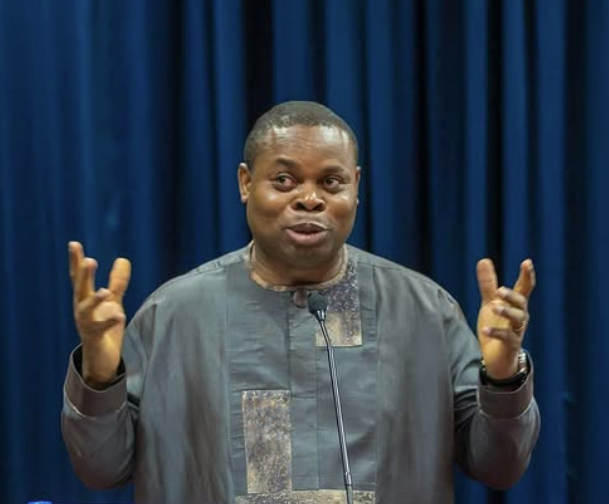
Senior broadcast journalist at Joy FM, Mr. Kojo Yankson, has also waded into the debate, calling for a fact-based and non-political assessment of the reported US$214 million loss recorded by the Bank of Ghana under the Gold-for-Reserves Programme, stressing that the figure has been wrongly politicized and misattributed to the Ghana Gold Board.
Speaking on the Newspaper Review Segment of the Joy SMS, Mr. Yankson said the controversy surrounding the figure should not be treated as a political issue, noting that the IMF’s report was based on verifiable data provided by Ghanaian authorities.
“I am curious about how the Bank of Ghana and the GoldBod US$214 million became easy to politicise,” he said. “We are talking about data and statistics. These are verifiable facts. The IMF didn’t make anything up; they worked with data from Ghana.”
Mr. Yankson clarified that the US$214 million referenced in the IMF report represents a trade loss on the books of the Bank of Ghana, not GoldBod, and cautioned against conflating the roles of the two institutions.
“Let me be clear, this was a trade loss on the books of the Bank of Ghana and not the GoldBod,” he stated. “We are seeing reports that GoldBod actually made a surplus of between GH₵700 million and GH₵800 million.”
According to him, the loss identified by the IMF was incurred under the Bank of Ghana’s gold purchase programme and should be understood within its strategic policy context.
“It was a loss, there is no doubt about it, but it was also a strategic loss,” Mr. Yankson said. “The Bank of Ghana strategically incurred that loss, and the evidence is quite clear.”
He emphasized that GoldBod’s role in the arrangement is limited to providing services to the central bank and does not extend to bearing trading losses under the programme.
“GoldBod is not involved in this because it is just a service provider to the Bank of Ghana in the gold trade,” he noted.
Mr. Yankson argued that when properly assessed, the macroeconomic benefits derived from the Gold-for-Reserves Programme far outweigh the reported trade loss.
“The gains that the Bank of Ghana made from the Gold-for-Reserves programme far outstrip the US$214 million loss. That is the point,” he said.
He urged the public to acknowledge the strategic intent behind the programme, noting that it was not designed by the current administration and should therefore not be framed as a partisan issue.
“This should not be made a political thing because it is not even this government that created the Gold-for-Reserves programme,” he said.
Mr. Yankson observed that the IMF itself has not called for the programme to be discontinued but has merely reported the financial outcome alongside its economic impact.
“The IMF has reported the fact that there was a loss, but the Bank of Ghana has also said it knew there would be a loss and proceeded because of the gains,” he said, pointing to the recent performance of the cedi as evidence.
“Look at how our cedi has performed for the first time ever,” he added.
Kojo Yankson is one of many journalists who have commented on the issue, with majority calling for GoldBod to be excluded from the brouhaha.
The discussion, however, has expanded beyond official responses, with media personalities, academics and civil society actors also weighing in on the matter.