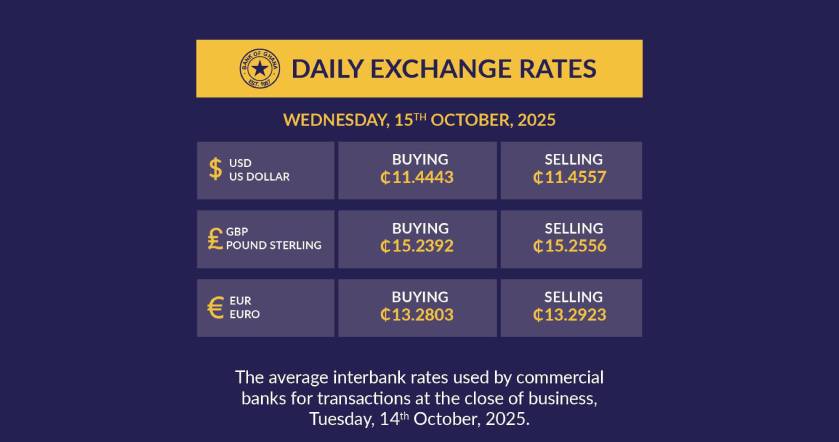
Value of cedi keeps soaring as Goldbod continues to be model for Africa
The recent appreciation of the Ghanaian cedi has been attributed to several economic factors. However, economists and financial analysts have highlighted the significant role of the Ghana Gold Board (GoldBod) in improving foreign exchange liquidity through gold accumulation and the Bank of Ghana’s reserve-building strategy.
The increase in gold reserves has strengthened Ghana’s foreign exchange buffer, boosted investor confidence, enhanced fiscal credibility, and supported capital inflows.
Ghana’s central bank gold reserves climbed to 37.06 tonnes by the end of September 2025, driven largely by GoldBod and its domestic gold procurement strategy.
The increase, representing a 21.3% rise from 30.53 tonnes in January, signals a strategic shift to position gold not only as a mining export but also as a key reserve asset for strengthening Ghana’s economic resilience.
Before the recent increase, the Bank of Ghana held only 8.78 tonnes of gold reserves in 2023, limiting the asset’s potential contribution to foreign reserve accumulation, currency stability, and protection against global financial shocks.
Sammy Gyamfi, Chief Executive Officer of the Ghana Gold Board, believes the institution will continue to make a significant contribution to Ghana’s economy by increasing foreign exchange inflows.
“GoldBod has substantially increased Ghana’s foreign exchange inflows and contributed to stabilizing the cedi, with over $6 billion in annual gold export revenues,” he stated.
“We are dedicated to transforming Ghana’s gold trading industry to maximize national benefits through responsible sourcing, supply chain traceability, value addition, and sustainability,” Mr. Gyamfi declared in a recent statement.
The GoldBod model has also attracted interest from other African countries, with Sierra Leone’s Finance Minister exploring how Ghana’s approach could be adapted to support sustainable reforms in the country’s gold sector.
By harnessing the country’s gold resources, GoldBod is positioning the mineral sector as a key driver of economic growth and stability in Ghana, while offering a potential model for other resource-rich African nations.
Adding to the growing endorsements, Finance Ministers from five African countries have hailed Ghana’s pioneering GoldBod model as a benchmark for resource-led development across the continent.
The meeting, held on the sidelines of the 2025 IMF–World Bank Annual Meetings in Washington, D.C., highlighted Ghana’s approach to natural resource governance and its potential to support sustainable economic development.
The high-level meeting brought together Finance Ministers from Ghana, Liberia, Sierra Leone, The Gambia, and Sudan for strategic discussions with the President of the African Development Bank (AfDB) Group, Dr. Sidi Ould Tah.