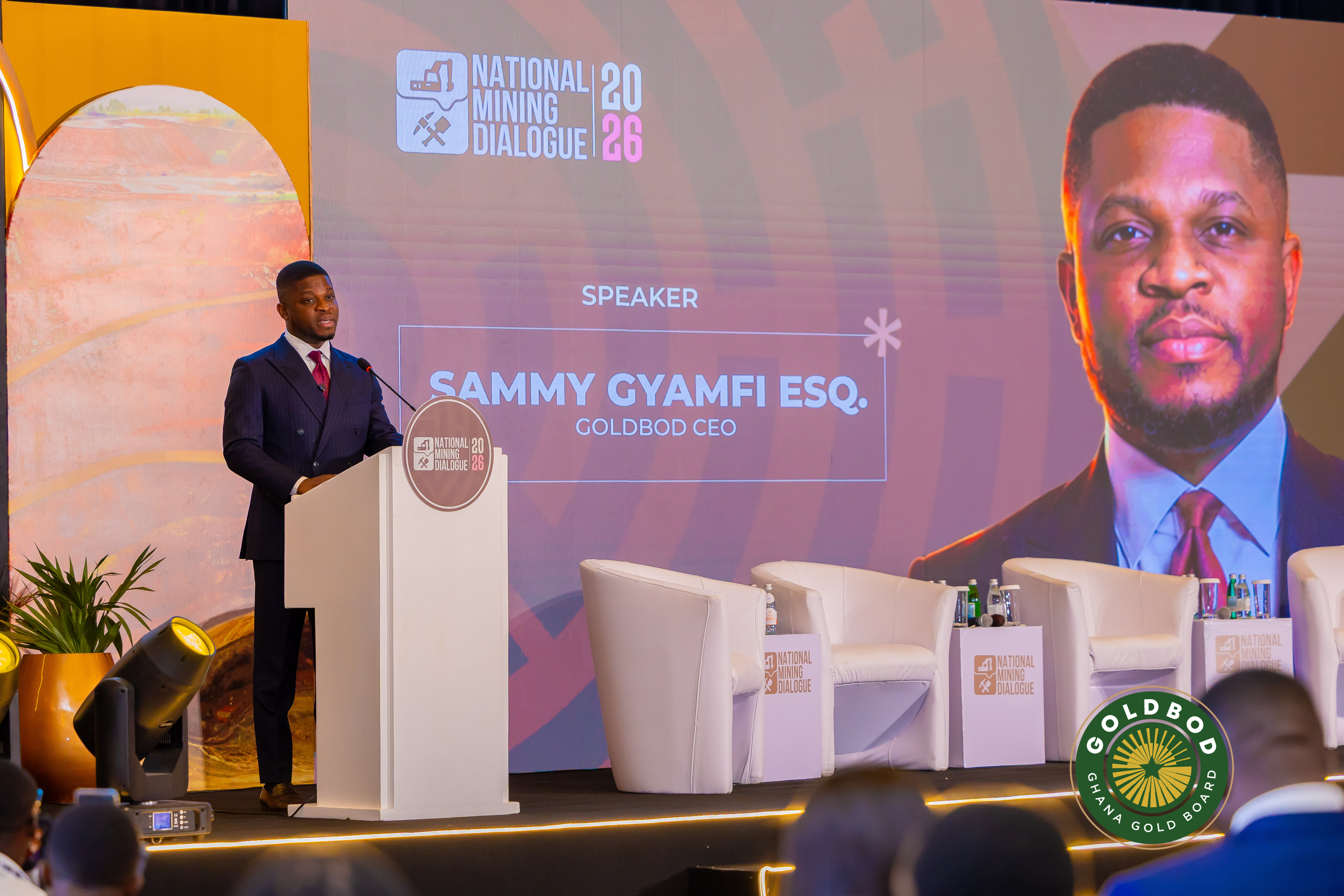
Speech Delivered By The CEO of GoldBod At The National Mining Dialogue
Your Royal Majesty the Ga Mantse, Esteemed Traditional Leaders; the Chief of Staff, Honourable Minister for Lands and Natural Resources; Honourable Ministers of State; Members of Parliament; the Chief Executive Officer and officials of the Minerals Commission; the President and Members of the Ghana Chamber of Mines; Chief Executive Officers and representatives of mining companies; leaders of the artisanal and small-scale mining sector; development partners; distinguished guests; ladies and gentlemen: good afternoon to you all.
It is a privilege to join you at the National Mining Dialogue 2026. I commend the organisers for convening this important platform to shape the future of our mining industry, particularly at a time when Ghana must speak frankly to itself.
The theme before us, “Rethinking the Social Licence to Operate,” is not just a sweet conference slogan. It is a political, economic and moral demand. Natural resources are God’s gift to the communities that host them and a blessing to the State. If those resources do not transform the communities from which they are taken, then we have not fully converted blessing into development.
The social licence to operate is built not only on legal authority, but on the confidence that mineral wealth serves both the national interest and host communities. We cannot continue to mine gold from the soil of our communities while poverty, lack of access to potable water, poor roads, youth unemployment and weak local economies remain the daily reality of too many mining communities in our country.
This is one of the reasons why the visionary NDC/Mahama government established the Ghana Gold Board. Ghana needed a new approach to managing one of its most strategic natural resources: an approach that retains more value locally, strengthens reserves, supports responsible downstream industries, and helps formalise a productive artisanal and small-scale mining sector. GoldBod’s mandate is therefore not merely to trade gold. It is to help ensure that every ounce of gold produced in Ghana creates greater value for Ghana.
The Youth Question Is the Social License Question
For me, the strongest reason to rethink the social licence is the youth question. In our mining communities, young people see wealth leave their land, yet too many do not see any path to decent work, skills, ownership or a meaningful future. That contradiction is dangerous. It is not fair. And it is not sustainable.
A social license cannot survive where the youth believe mining has no place for them except as casual laborers and bystanders, while others see them as troublesome agitators. The social license must therefore be re-imagined as a development compact with the youth: a compact that integrates the youth in responsible mining through capacity building, creates sustainable jobs, supports local enterprise, opens services around production, and gives young people a stake in the future of mining.
That is why mining communities must no longer be treated as land donors. They are custodians of the resource hence must be treated as development partners and economic shareholders. If we accept that truth, then we must confront a hard question: after more than a century of mining, why are too many Ghanaians still spectators in the ownership and value of the mines?
One Hundred Years of Mining Cannot Leave Us as Spectators
Ghana has mined gold commercially for more than a century. Yet, for most of this long history, Ghanaians have not been the real value owners of the mines. The large-scale mining sector has been largely foreign-led, and too much of the value has leaked out of the country through ownership structures, financing arrangements, imported inputs, offshore services, limited beneficiation and weak local industrial linkages.
That is why Obuasi can produce gold for generations and still not compare to Johannesburg in industrial depth, urban development and economic opportunities. This is not because Obuasi lacks resources. The state of development in Obuasi points to a truism that extraction without intentional policy does not automatically produce transformation. Mines do not build nations by accident. Nations build value through deliberate ownership, strategic partnerships, infrastructure, linkages, reinvestment and disciplined policy management.
If we want a new story, we must own more, refine more, process more, fabricate more and retain more. Communities must be active participants in the value chain, from exploration services and production support to logistics, fabrication, environmental services, refining, jewellery and downstream enterprise. When these roles are localised, a mine becomes more than a pit or shaft; it becomes a training ground, a market, an industrial anchor and a platform for youth enterprise.
Gold Must Transform Communities
Gold is not a marginal commodity in Ghana’s economy. It is currently our most dominant export commodity. The latest 2025 merchandise trade data show total exports of about US$32.0 billion, with gold earning about US$20.2 billion and accounting for roughly 63.1 percent of export earnings. Undoubtedly, Gold has helped drive record trade surpluses, strengthened national reserves, supported currency appreciation and anchored Ghana’s recent economic stability.
The policy consequence is clear: gold is both a strategic asset and a moral responsibility. It must stabilise the economy, but it must also transform the communities from which it comes. This is part of the logic behind the Ghana Accelerated National Reserve Accumulation Programme (GANRAP). Ghana is deliberately using a portion of its mineral wealth to strengthen reserves and build economic resilience. That same intentionality must now reach host communities more directly.
Let us also recognise the critical role of artisanal and small-scale mining. Recent 2025 data show that Ghana produced about 5.94 million ounces of gold, with ASM contributing about 3.11 million ounces, or 52.4 percent of national output. For the first time in over a century, artisanal and small-scale miners overtook large-scale producers. ASM has become a major driver of Ghana’s gold output and of the macroeconomic benefits gold now delivers. This proves that when Ghanaians become active value actors, their productivity will power national development.
GoldBod, Local Ownership and the New Value Agenda
Ladies and gentlemen, development is not accidental. It is the product of intentional policy, disciplined management and resource optimisation. If gold is God’s gift to our communities and a blessing to the State, then the State must leverage it to rewrite the story of mining communities.
This is why GoldBod matters. GoldBod is not merely a trading institution. It is a national value-retention instrument established to bring order, traceability, transparency and greater Ghanaian benefit into the gold trade sector, particularly the ASM sector. Through market formalization, responsible sourcing, local refining, and support for downstream industries such as Jewelry manufacturing, GoldBod is helping to shift Ghana from extraction to value creation.
As a country, we have not optimised impact because too much ownership, financing, refining, services and downstream activity happens outside the communities and outside Ghana. That must change and the John Mahama government and GoldBod remain poised to rewrite the story.
A Government Reform Agenda for Transformational Mining
Government must therefore pursue bold reforms that optimise returns from gold and other natural resources; expand responsible exploration; support indigenous ownership; formalise artisanal and small-scale mining; win the fight against illegal mining; accelerate local refining and local value addition; strengthen traceability; and convert mining revenues into visible development in host communities.
We must also make production services around mining real opportunities for host communities: catering, transport, security, maintenance, reclamation, environmental monitoring, agriculture supply, housing and local commerce. A young person in Tarkwa, Obuasi, Prestea, Bibiani or Ahafo should see mining not as a distant concession, but as a chain of opportunities: a contract to supply, a workshop to run, a skill to learn, a business to build, and a future to claim.
To organise these reforms clearly, I propose a simple but urgent model: IPE — Involve, Protect, Expand. The youth factor is not a side issue; it is the urgency of this dialogue. The IPE model must be judged by whether it connects mineral wealth to the future of our youth. A country that fails to do that is sitting on both wealth and unhinged risk.
The IPE Model: Involve, Protect, Expand
Distinguished guests, by “INVOLVE” I mean:
- Communities must become consent providers, not afterthoughts, because Accra cannot determine their fate without them;
- Communities must be recognised not as land donors, but as economic shareholders in the wealth they host.
- Communities must move from consultation to strategic partnerships. They must have a meaningful voice in licensing, clearer access to mining-related opportunities, and deliberate youth pathways into capacity building, mining services and alternative livelihoods.
- Local royalty retention must be higher and more decentralised, so development funds reach the people directly;
- Every new mine must come with clear local jobs, services, enterprise and infrastructure commitments;
- Definite corporate social responsibility contracts must move mining areas from discretionary projects to predictable transformation, helping communities, district assemblies, traditional authorities and citizens see how mineral wealth translates into a shared national development.
- More importantly, we must promote more indigenous ownership of mines. We must support Ghanaian capital to participate meaningfully in exploration, mine development, mining services and value addition. We must expand geological work, open new fields responsibly, and ensure that as production grows, local value also grows. Production without ownership is limited. Production without value addition is leakage. Production without community transformation is a broken social contract.
Ladies and gentlemen, by “PROTECT” I mean:
- Water bodies, forests, farmlands and public health must be treated as non-negotiable national assets. The social licence of mining cannot coexist with poisoned rivers and devastated forest reserves;
- Reclamation and reforestation must be mandatory and effectively enforced;
- ASM formalisation, traceability and compliance must separate responsible miners from destructive actors;
- Culprits of irresponsible mining must be prosecuted and punished in accordance with law.
Fellow countrymen and women, by “EXPAND”, I mean:
- Indigenous ownership and Ghanaian capital must be deliberately supported across exploration, production and services;
- Local refining, Jewelry fabrication and downstream industries must be built around production;
- Responsible and formalized ASM operators should be supported with appropriate hard-rock mining equipment, with repayment models that strengthen GoldBod’s gold aggregation, while increasing national gold output and mitigating environmental risks.
What GoldBod and Government Are Doing to Drive IPE
Having set out my IPE proposal, let me be clear that this is not theory. This is where passion must push implementation and the social licence must be renewed through visible action. GoldBod and Government are already driving this agenda.
The GoldBod since its establishment has waged a restless war against gold smuggling, ensuring the export of about 170 tonnes of ASM gold through formal channels from 2025 to date. This has generated foreign exchange of over $17 billion USD for the country thereby strengthening FX market stability, foreign reserves and macroeconomic stability. This is ensuring that Ghanaians directly benefit from the exploitation of the mineral wealth of the nation through improved living conditions.
Aside this important achievement, the GoldBod is involving Ghanaians more directly in the gold economy and expanding Ghana’s share of value beyond extraction. The GoldBod has made local gold trading the preserve of Ghanaians and is opening space for Ghanaian jewelers, refiners and young entrepreneurs to move from spectators to active value actors.
The GoldBod is fast-changing Ghana’s tragic story of zero local refining of its gold resources. This year alone, nearly nine (9) tonnes of gold aggregated by the GoldBod has been refined right here in Ghana. This is helping to create sustainable jobs while retaining refining fees and associated benefits in the Ghanaian economy.
The planned Ghana Gold Village to be established by the GoldBod in partnership with the private sector, will support world-class local jewellery manufacturing, gold fabrication and international markets for Ghanaian gold products. The implementation of this project will be led by our subsidiary, GoldBod Jewelry Limited and serve as a platform for skills, enterprise, jobs and industrial growth.
The GoldBod is also preparing to roll out a gold tokenization program in 2027 to promote fractional ownership of Ghana’s gold resources by citizens and Africans. Through this initiative, citizens with modest funds can participate in gold-backed investment opportunities. The objective is simple: we must all own and share in the mineral wealth of our nation.
Ladies and gentlemen, the GoldBod is also supporting government’s fight against the illegal mining menace and the protection of our environment. In addition to the donation of pick-up vehicles and a cash amount of GHS5 million to the National Anti-Illegal Mining Operations Secretariat (NAIMOS) last year, the GoldBod is currently in the process of procuring high-spec speed boats for the NAIMOS to strengthen the fight against illegal mining particularly in and around water bodies.
In close collaboration with the Ministry of Lands and Natural Resources, the Minerals Commission and RCOMSDEP, the GoldBod will in the year 2027 commence an ASM Formalisation and Financing Support Program (FFSP) designed to transition artisanal miners into legal, responsible and OECD-compliant operators through regulatory compliance, capacity building and financing support in the area of concession viability, equipment financing and mining services.
Also, the GoldBod is scheduled to contract a technology-driven traceability system by the end of the year to strengthen responsible sourcing, improve accountability and make illegal and irresponsible mining less attractive. A National Competitive Tendering process for this system is currently underway.
Under our statutory mandate to support sustainability initiatives, the GoldBod has commenced reclamation of 50 hectares of degraded land in the Tano Nimri Forest reserve. We plan to scale-up our reclamation program to cover a further 100 hectares of devastated forest lands next year.
Under our Environmental, Social and Governance policy, the GoldBod is fully-funding the rehabilitation of three of the six water treatment plants of the Ghana Water Limited shut down as a result of poor water quality linked to irresponsible mining and other activities. These three plants; Daboase, Sekyere Hemang and Bonsa, serve over 76 communities and about 100,000 users in the Western and Central Regions. The rehabilitation of the remaining three Water Treatment Plants; Kwanyako, Baifikrom and Essagyir, will also be fully-funded by the GoldBod next year.
Through the Ghana Accelerated National Reserve Accumulation Programme, gold acquired from Large-scale mining companies for shoring up national gold reserves is intended to be refined locally, effective July 1, 2026. Government has shifted from the earlier 20 percent offshore acquisition arrangement for large-scale mining gold to a 30 percent local acquisition of large-scale mining output. This will feed local refineries and set us right on the path to LBMA certification for local refineries.
The GoldBod is also addressing one of the biggest barriers to Ghanaian participation in mining: the risk capital required for geological investigations. Under its Mining Support Programme, GoldBod is partnering with the Ghana Geological Survey Authority to undertake geological studies of mineralised areas, de-risk investments, attract credible international investors, and responsibly expand Ghana’s mining base. Geological investigations are currently ongoing at Funsi in the Upper West Region and Bensere in the Ashanti Region. These studies will help build a reliable investment-grade asset portfolio, reduce investor risks and position GoldBod to negotiate stronger equity stakes in the resulting model mines that will be established under this program. These are not ordinary commercial interventions; they are strategic investments to expand production, ownership and socio-economic impact for Ghana.
Furthermore, to address the problem of purity losses in the ASM gold trade space and under-declaration of mining revenues in general, the GoldBod will by November this year, 2026 commence the construction of an ultra-modern, ISO certified National Assay Laboratory in Ghana. This will completely transform Ghana’s primitive assay regime and enable the GoldBod as the National Assayer to undertake the golden standard of assay (Fire Assay) on all ASM and large-scale gold output before export. The land for this project has already been secured by the GoldBod at the Aviance Cargo Village at the Accra International Airport. Architectural drawings and Bills of Quantities have been finalized. And a procurement process is currently underway to select a contractor for the project.
Conclusion – A Shared Responsibility
In conclusion, ladies and gentlemen, the task before us is not simply a decision to mine more gold or not. It is about how we involve, protect and expand to justify the social licence to operate.
We must build a mining economy that produces dignity, opportunity, resilience and transformation for our kith and kin while protecting our environment.
Communities, traditional authorities, development partners, civil society, the media, academia and the private sector all have a role in making this social licence real.
Together, let us build a mining sector where the child of a mining community can easily aspire and become a geologist, engineer, jeweller, fabricator, environmental scientist, equipment operator, entrepreneur or mine owner. Let’s build a mining sector where communities do not merely hear of the benefits of mining but experience them; a mining sector, where regulators are respected because they are firm, fair and transparent.
If we get this right, Ghana will not only produce gold. Ghana will produce prosperous mining towns, strategic industries around its minerals and deeper community trust.
So let this National Mining Dialogue mark a turning point. Let it be the moment we chose to involve, to protect and to expand, not as slogans, but as a national duty to our youth, our communities, our environment and generations yet unborn.
Thank you for your attention and may God bless our homeland Ghana.